
Warehouse Optimization: Finding the Real Bottleneck Before Adding More Labor or Space
When a warehouse starts falling behind, the most obvious solution is often to add something.
More people.
More space.
More equipment.
More automation.
But before investing in any of those things, there's a more important question:
What is actually preventing the warehouse from processing more orders?
Warehouse optimization isn't simply about making employees work faster or fitting more inventory into the building. It's about understanding how inventory and orders move through the entire operation and finding the point where that flow begins to break down.
The Most Visible Problem Isn't Always the Real Problem
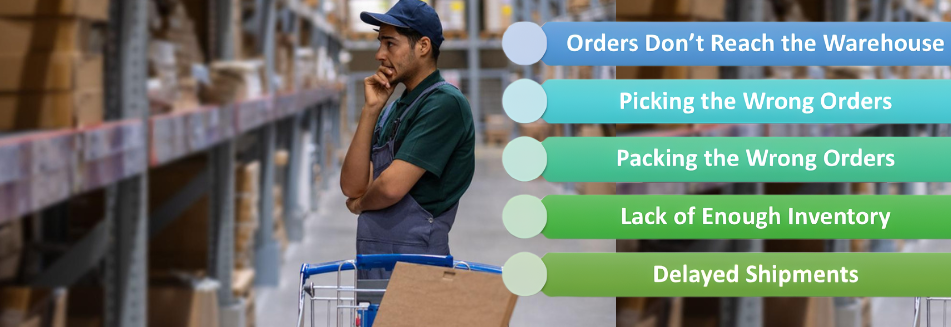
Picking often receives the most attention because it's one of the most labor intensive parts of fulfillment.
If orders aren't getting completed quickly enough, it can appear that picking productivity is the problem.
But imagine a picker arriving at a location and finding it empty.
The picker waits for replenishment.
The replenishment team is behind because the forward pick locations don't hold enough inventory.
Those locations may be undersized because demand has changed, but minimum and maximum quantities haven't been updated.
Or perhaps inventory isn't available for replenishment because receiving and putaway are behind.
What originally looked like a picking problem may have started several steps earlier.
That's why effective warehouse optimization starts by finding the root cause rather than reacting to the symptom.
Think About the Warehouse as One Connected Operation
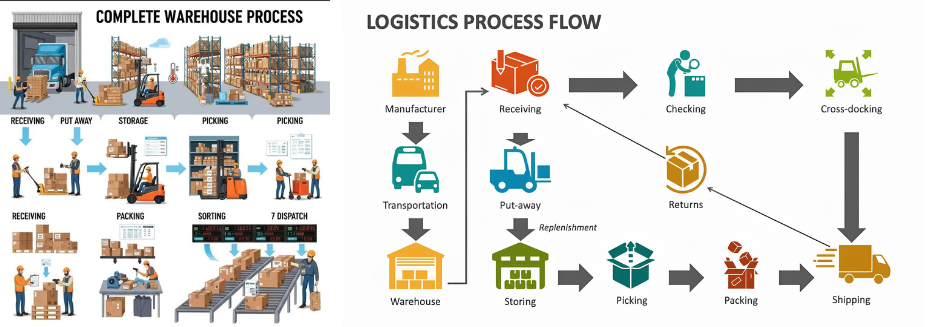
Receiving, putaway, storage, replenishment, picking, packing, shipping, and returns aren't independent functions.
Each one affects what happens next.
If receiving falls behind, inventory isn't available.
If putaway is delayed, replenishment can't access inventory.
If replenishment falls behind, pick locations become empty.
If picking falls behind, packing waits.
And if packing produces orders faster than shipping can process them, you've simply moved the bottleneck downstream.
Improving warehouse throughput requires looking at the entire operation instead of optimizing one department at a time.
Small Inefficiencies Add Up
Warehouse performance doesn't always decline because of one major problem.
Often, inefficiency builds gradually.
Product demand changes, but slotting stays the same.
Pick locations aren't resized.
Inventory inaccuracies increase.
Employees develop workarounds.
Packing stations become cluttered.
Replenishments carry over from one day to the next.
Individually, these issues may not seem significant. Combined, they can have a major effect on productivity and customer service.
That's why some of the best warehouse improvements don't require expensive technology.
Sometimes, the opportunity is simply restoring good operational discipline.
Start With the Basics
Before looking at major investments, follow inventory through the building.
Receiving: How quickly does incoming product become available in inventory?
Putaway: Is received inventory reaching the correct storage location efficiently?
Replenishment: Are forward pick locations stocked before they're needed?
Picking: Are employees spending their time picking, or are they walking, searching, and waiting?
Packing: Can packing keep pace with the orders being picked?
Shipping: Are completed orders staged and leaving the facility on time?
Returns: How quickly is returned product inspected and returned to sellable inventory?
Looking at each step makes it easier to determine where the operation is actually losing time.
Measure the Entire Flow
One of the biggest mistakes in warehouse optimization is measuring improvement within a single department.
Suppose a new picking method increases picks per hour by 20%.
That's great, unless packing can't handle the additional volume.
Now the warehouse has faster picking but a larger packing backlog.
The individual metric improved.
The warehouse didn't.
Useful warehouse measurements should ultimately connect back to overall throughput and service, including dock to stock time, inventory accuracy, replenishment completion, picking productivity and accuracy, packing backlog, order carryover, and on time shipment performance.
The objective isn't to make one department look better.
It's to move more inventory accurately through the entire operation.
Know When the Constraint Moves
Solving one warehouse bottleneck often reveals another.
That's normal.
If receiving improves, putaway may become the next constraint.
Improve replenishment and picking may accelerate.
Improve picking and packing may need attention next.
Warehouse optimization isn't a one time project. It's a continuous process of identifying the current constraint, correcting it, measuring the result, and determining where the next opportunity exists.
Technology Should Solve a Problem, Not Define It
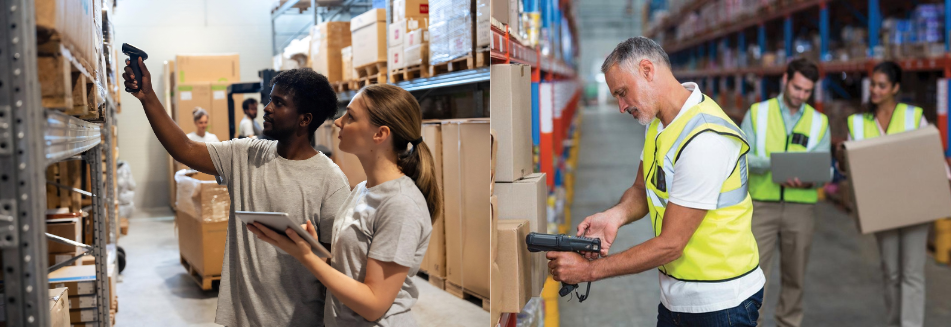
Warehouse technology can create tremendous efficiencies.
Warehouse management systems, scanners, automation, improved integrations, and better reporting can all increase productivity.
But technology works best after the operational problem is understood.
Buying automation before identifying the constraint can simply automate the wrong process.
The same applies to adding warehouse space.
A building that feels full may actually have poor slotting, excessive inventory, inefficient storage configurations, or slow moving product occupying valuable locations.
Before spending money to solve a warehouse problem, make sure you're solving the right problem.
Better Warehouse Operations Create Better Customer Experiences
Customers rarely see what happens inside a warehouse.
They experience the result.
Was the product available?
Was the order accurate?
Did it ship on time?
Did the retailer receive a compliant shipment?
Could inventory be replenished to Amazon when it was needed?
Those outcomes depend on dozens of warehouse processes working together.
At Weisser Distributing, our approach to fulfillment looks at the complete movement of inventory, from receiving and storage through picking, packing, marketplace preparation, wholesale fulfillment, shipping, and returns.
Combined with the marketplace expertise of Marketplace Pros, that allows physical warehouse operations and marketplace strategy to work together instead of independently.
Because warehouse optimization isn't simply about working faster.
It's about creating an operation where inventory can move accurately, efficiently, and consistently from the receiving dock to the customer.